Holy Wisdom-Bloody Minded
- By Jason Gibbs
- 19 January, 2014
- No Comments

I have always wanted to see the Hagia Sophia. More so than the pyramids at Giza or the Acropolis at Athens. More so maybe than any other place. Top three in any event. Something about the way the sheer bulk and breadth of its buttresses conspires with its enormous and elegant not-quite-floating domes is more science fiction than historical fact. A thing more likely to have sprung from the imagination of Tolkien than the ambition of Justinian. In fact, I get a little Tolkienesque (is that a word?) when thinking about it. I can’t help but imagine Gandalf the Grey saying “Behold the third church of Holy Wisdom, the great dome of the Hagia Sophia”. Part fortress, part cathedral, it sits like some kind of great beast on it’s promontory, guarding the golden horn and keeping watch over the lost kingdom of Byzantium.
HOLY WISDOM- BLOODY MINDED
The story of the Hagia Sophia begins the moment the emperor Justinian met Theodora, his wife. Theodora was a dancer. And by dancer I mean DANCER. As a child she was employed at the hippodrome where she was an actress (a term synonymous with with anything from acting to burlesque dancing to flat out hooking) and also a bear trainer. I’ll let that sink in. I imagine that, then as now, the hooker/bear tamer combination was a solid foundation from which to launch a political career. I expect ivy league schools to begin offering courses and bundling them any day. Seriously, they’d be printing money. Are you listening Harvard? You can thank me later.
At some point along the way, though, she had a religious conversion and traded in the bear whip and the stage to become a seamstress. She spun wool near the imperial palace. It was here that she met a young Justinian, and they fell in love.
Theodora was by all accounts beautiful, smart, ambitious, and generally a force to be reckoned with. And the combination of Justinian and Theodora seems to have been too much for anyone to overcome. Justinian was crowned emperor in 527 CE.
The Empire of eastern Rome was, at the time, a shadow of its former self. Justinian sought to remedy that and quickly. He began a campaign of expansion. Retaking much of the lost territory to the west and at great cost to the populace, he implemented a taxation campaign that was as ruthless as it was creative. A number of soldiers it seems, after dying in battle to retake land, would then selflessly cut their families out of their wills and leave everything they had to …. wait for it… Justinian. Policies like these made him wildly unpopular. It turns out that conscripting the young into battle then using their deaths as a pretext to take all their land and money does not endear one to the population.
In the year 532 the hippodrome was the center of recreation in Constantinople and chariot racing was the national sport. There were four major competing chariot racing teams: The Reds, Greens, Blues, and Whites. It was not uncommon for fans of one team or another to riot, and sometimes murder each other. Football hooligans have nothing on pissed off chariot racing fans. It’s as if modern street gangs, instead of all just being Raiders fans, organized themselves according to the sports team they liked best.
This division among the mob was often used as a tool by the government. The different factions would seek to curry favor with the emperor for advantage, and the emperor could emphasize one group over another for his own political reasons. Sort of like an early hunger games. Like the hunger games it served to destabilize the populace. But unlike the hunger games it also empowered the mob. In the winter of 532 an unpopular emperor was going to run headlong into an angry mob and some extremely real shit was about to happen.
On or about the tenth of January several members of the Blues and the Greens had been arrested for a disturbance and were sentenced to be hanged. But someone fucked up the hanging and two of the men survived, escaped, and sought refuge in a church. It was the cause of freeing these two men that would unite the Blues and Greens against the government in common purpose.
The imperial palace was adjacent to the hippodrome (roughly the same spot as the Blue Mosque is in now) and thus it was easy for the emperor to watch the races from the safety of his home. He was, however, also visible to the crowd as he was doing so. On January 13th, 532 during a chariot racing event the Blues and the Greens began chanting “Mercy, mercy” for the pardon of the two men. When there was no response the chant changed to “Long live the merciful Blues and Greens. That night, with nika (“conquer”, a common encouragement for a charioteer) as their watchword, they demanded that the prefect release the prisoners. When he did not they set fire to the praetorium. Over the course of the next several days they set fire to the city, and laid siege to the imperial palace. They even installed a new emperor (although the gentleman in question was wise enough to not be found).
Justinian was ready to flee in terror. He loaded as much treasure as he could and sent it to the harbor. It was now, as he was preparing to abandon his empire, that his wife stepped to the fore, and slapped some nonsense back into him. She excoriated her husband and his court, she shamed them for wanting to flee, and declared that it was better to die as royalty than live as anything else.
| “I do not care whether or not it is proper for a woman to give brave counsel to frightened men. But in moments of extreme danger, conscience is the only guide. Every man who is born into the light of day must sooner or later die, and how can an emperor ever allow himself to become a fugitive? If you, my lord, wish to save your skin, you will have no difficulty in doing so. We are rich. There is the sea. There too are our ships. But consider first whether when you reach safety, you will not regret that you did not choose death in preference. As for me, I stand by the ancient saying: ‘The imperial purple makes the best shroud.’” |
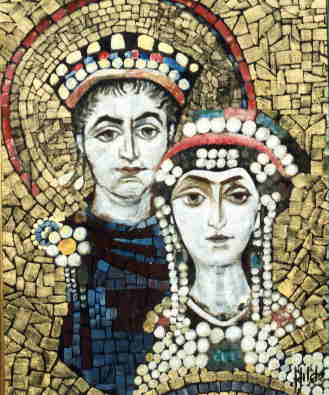 The love of a megalomaniacal bear tamer/stripper is hard to ignore. And so it was that Justinian gave up his flight. He still had no taste for death, however, so he sent word to the leaders of the revolt to meet him in the hippodrome- The emperor was ready to talk terms… and by talk terms what he meant was murder them all.
Important historical note: If you are the leader of the opposition, and the person you are opposing is a medieval king of any kind, and he wants to meet you in an enclosed space under a banner of truce… then he is either going to burn it to the ground of fill it with soldiers. In this case it was the latter. And so it was, that under a white flag and a blue byzantine sky, Justinian brought a bloody end to the uprising and ensured his rule would not be questioned from within his empire again.
But what does any of this have to do with the Hagia Sophia? Justinian’s task was now to rebuild the imperial city. Including the imperial church. It would have to be a monument worthy of his vision, a temple comparable in size and scope to the blind ambition of a bear taming burlesque dancer.
Leave a Reply